
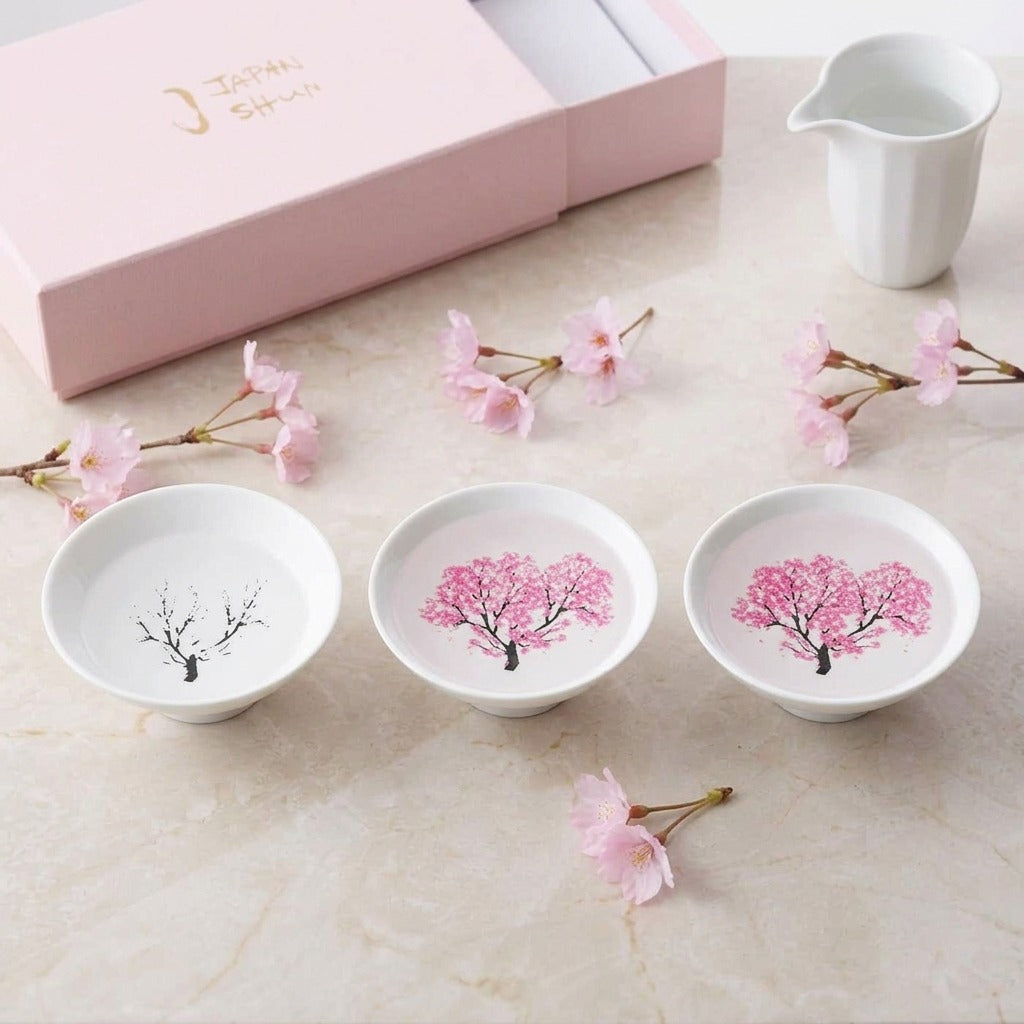
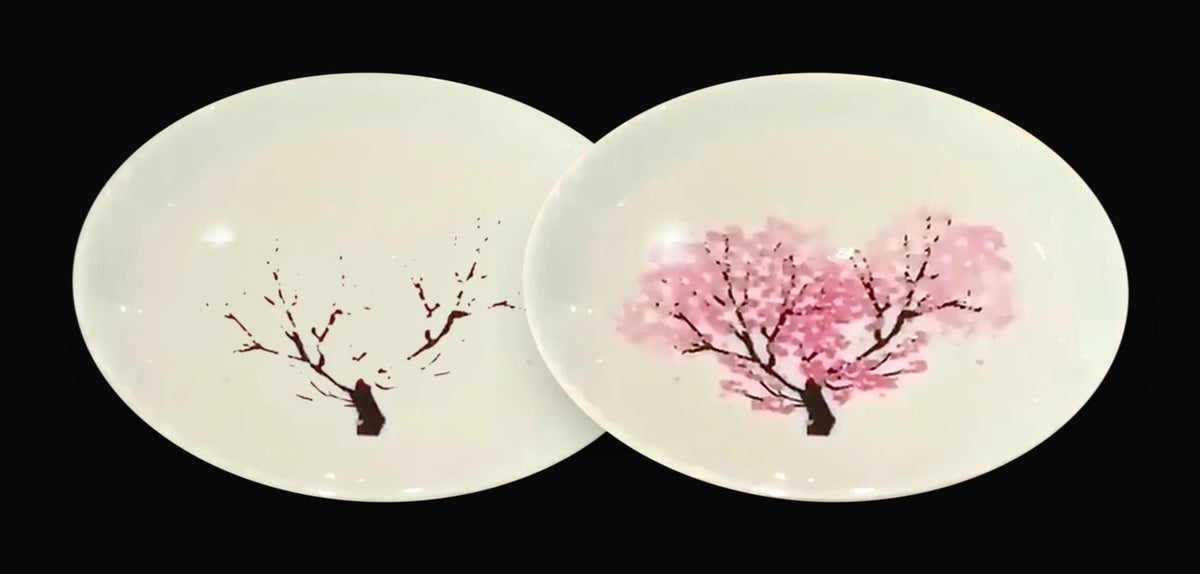
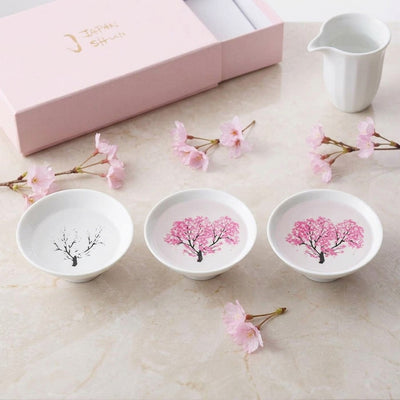
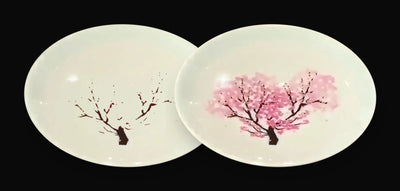

Only the cups are included: the pitcher, box and blossom branch in the photographs are styling. The before-and-after shot is composited from our own footage of the cup and colour-balanced so the white reads white; its two cups are staged at different temperatures on purpose.
EXTORIL · Mino ware, Tajimi, Japan
HIYAZAKURA TRIOThree colour-changing sake cups
Plain white until you pour something cold. At 17°C / 63°F and below, cherry blossoms open across the white ceramic — deeper pink the colder the drink. Let it warm and the cup goes white again, ready for the next pour.
Three cups. For the evening that does not end at two.
How many at the table?
 ONE
1 cup
€25,95 EUR
ONE
1 cup
€25,95 EUR
 RecommendedPAIR
2 cups
€45,95 EUR€50,95−10%€22,97 per cup
RecommendedPAIR
2 cups
€45,95 EUR€50,95−10%€22,97 per cup
 Best valueTRIO
3 cups
€56,95 EUR€75,95−25%€18,98 per cup
Best valueTRIO
3 cups
€56,95 EUR€75,95−25%€18,98 per cup
Every pack holds the same cup; only the number changes. Prices are read live from the store.
€56,95 EUR
€75,95 EUR−25%You save €19,00 EUR
€18,98 per cup
Buy TRIO goes straight to checkout. Taxes and any shipping are calculated there.
- In the box
- 3 cups · pitcher not included
- Blooms at
- 17°C / 63°F or below
- Returns to white
- At room temperature, every time
- Made in
- Tajimi, Gifu, Japan · MARUMO TAKAGI
- Care
- Hand-wash only
01 / WHAT HAPPENS WHEN YOU POUR
Hanami, without waiting for April.
No switch, no app, no batteries. The line is 17°C / 63°F; the cup does the rest, and it does it every time.
Set it down.
White ceramic, nothing to look at.
Pour something cold.
17°C / 63°F or below. Sake from the fridge, iced water, a short cocktail over ice.
Pink opens across the cup.
The colder the pour, the deeper it goes.
The table goes quiet.
Then someone reaches for a phone. Let it warm and the cup goes white again, ready for the next pour.
02 / THE NUMBERS
Every measurement, as supplied.
- In the box
- 3 HIYAZAKURA sake cups
- Not included
- Pitcher, box and styling shown in photographs
- Manufacturer
- MARUMO TAKAGI
- Made in
- Tajimi, Gifu Prefecture, Japan
- Producing sake cups since
- 1887
- Technique
- Mino ware (Mino-yaki)
- Material
- Ceramic
- Size, per cup
- Φ9.0 × H3.4 cm (Φ3.54" × H1.33")
- Weight, per cup
- 180 g (0.4 lbs)
- Capacity, per cup
- 70 ml (2.37 oz)
- Reacts at
- 17°C / 63°F or below
- Returns to white
- At room temperature
Figures are the manufacturer's, per cup.
03 / CARE
Hand-wash only. Like everything worth keeping.
A temperature-reactive ceramic finish asks for a little care. All of it is easy. None of it is optional.
- Wash by hand in warm water with a soft cloth.
- Dry it by hand and store it out of the light.
- Pour anything cold into it. That is what it is for.
- No dishwasher.
- No microwave.
- No oven.
- No direct flame.
- No IH induction hob.
- No scouring brushes, no abrasive cleaners.
- No long spells in direct sunlight — it fades the colour.
04 / QUESTIONS
Before you pour.
What is in the box?
Three HIYAZAKURA sake cups. Only the cups are included — any sake pitcher, box, tray or blossom branch in the photographs is styling. The same cup is in every pack; ONE, PAIR and TRIO differ only in how many.
Does the colour fade?
The blossoms are temperature doing the work, not something painted on that rinses off. Cold brings them up; as the cup warms, they go again. The care instructions are explicit about one real risk: long spells in direct sunlight will fade the colour, so keep it off a sunny windowsill. We do not publish a number of washes or years, because we have not tested one and will not invent one.
Is it safe to drink from?
Yes. It is a sake cup, made as drinkware by MARUMO TAKAGI in Gifu and meant to be used. Everything on the care list is about heat and abrasion — microwave, oven, flame, dishwasher, scouring pads — not about what you pour in it. Keep it cold, wash it by hand, drink from it.
What temperature, exactly?
17°C / 63°F or below. That is where the blossoms begin. Past that point the colder the liquid, the deeper the pink — sake straight from the fridge shows more than sake merely cool, iced water more again. At room temperature the cup stays white.
Can it go in the dishwasher?
No. Not the dishwasher, and not the microwave, the oven, an open flame or an IH hob. No scouring brushes, no abrasive cleaner either. Warm water, a soft cloth, by hand.
Does it work more than once?
Every time. The cup returns to white at room temperature and blooms again with the next cold pour — Marumo Takagi make the series specifically to be enjoyed over and over. Nothing is used up and nothing needs recharging. Pour, watch, let it warm, pour again.
What should I pour in it?
Anything cold. It was built for hiya — chilled sake — and that is still the best version of it: a sake cup's measure, small and deliberate, made to be refilled rather than nursed. Cold water works. So does white wine, a short cocktail over ice, iced tea, anything straight out of the fridge. Hot sake leaves the cup white.
Is it a good gift?
It is close to the ideal one. It explains itself in about four seconds, it asks nothing of the person receiving it, and it does its trick in front of other people — which is really what you are giving. PAIR is the usual choice: two cups means whoever opens it pours one for you. Pass the care list on with it. Hand-wash only.
What does HIYAZAKURA mean?
冷や (hiya) is the Japanese word for sake served chilled. 桜 (zakura) is cherry blossom. Chilled cherry blossom. It is also a description of the thing it does: hanami, the custom of drinking under the cherry trees, lasts a couple of weeks a year in Japan. This puts it on a table in November.
Shipping and returns
See Extoril's shipping and returns information, or contact us before you order.
05 / THE LISTINGThe full description, as written.ReadClose
Plain white. Until you pour something cold. HIYAZAKURA is a colour-changing Mino ware sake cup from Tajimi, Japan, and TRIO is three of them. Pour a drink at 17°C / 63°F or below and pink cherry blossoms open across the white ceramic; the colder the drink, the deeper the pink. Let a cup warm to room temperature and it goes white again, ready to bloom for the next pour.
TRIO: three cups
Three cups. For the evening that does not end at two.
In the box
Three HIYAZAKURA sake cups. Only the cups are included: any sake pitcher, box, tray or blossom branch in the photographs is styling, not part of the set. The same cup is in every pack. ONE, PAIR and TRIO differ only in how many cups they hold.
What happens when you pour
- Set it down. White ceramic, nothing to look at.
- Pour something cold: 17°C / 63°F or below.
- Pink opens across the cup. The colder the pour, the deeper it goes.
- Let it warm. The cup returns to white at room temperature and does it again next time.
Made in Tajimi, Gifu, by a maker of sake cups since 1887
Mino ware, Mino-yaki, is the ceramic tradition of Gifu Prefecture in central Japan. HIYAZAKURA is made in Tajimi, the largest ceramic-producing area in Japan, by MARUMO TAKAGI, who have been producing ceramic sake cups since 1887, when the company still traded as Marui Shoten. The colour change is temperature doing the work: cold brings the blossoms up, warmth takes them away, and the cup is made to do it over and over.
Specifications, per cup
- Manufacturer: MARUMO TAKAGI, Tajimi, Gifu Prefecture, Japan
- Technique: Mino ware (Mino-yaki)
- Material: ceramic
- Size: Φ9.0 × H3.4 cm (Φ3.54" × H1.33")
- Weight: 180 g (0.4 lbs)
- Capacity: 70 ml (2.37 oz)
- Colour change: from 17°C / 63°F down; returns to white at room temperature
Care
Hand-wash only, in warm water with a soft cloth. Dry it by hand and store it out of direct light.
- Not for the dishwasher
- Not for the microwave
- Not for the oven
- Not for direct flame
- Not for IH induction hobs
- No scrubbing brushes or abrasive cleaners
- Avoid prolonged direct sunlight, which fades the colour
The name
冷や (hiya) is the Japanese word for sake served chilled; 桜 (zakura) is cherry blossom. Chilled cherry blossom. Hanami, the custom of drinking under the cherry trees, lasts a couple of weeks a year in Japan. This puts it on a table in November.